
UCLA Study Finds Disparities in Mail Ballot Rejections and Evidence That Racial Cues May Influence Signature Reviews
FOR IMMEDIATE RELEASE
Contact: Alberto Lammers; alammers@luskin.ucla.edu
UCLA Study Finds Disparities in Mail Ballot Rejections and Evidence That Racial Cues May Influence Signature Reviews
Analysis of California and Washington state election data underscores the need for further research and stronger safeguards for eligible voters.
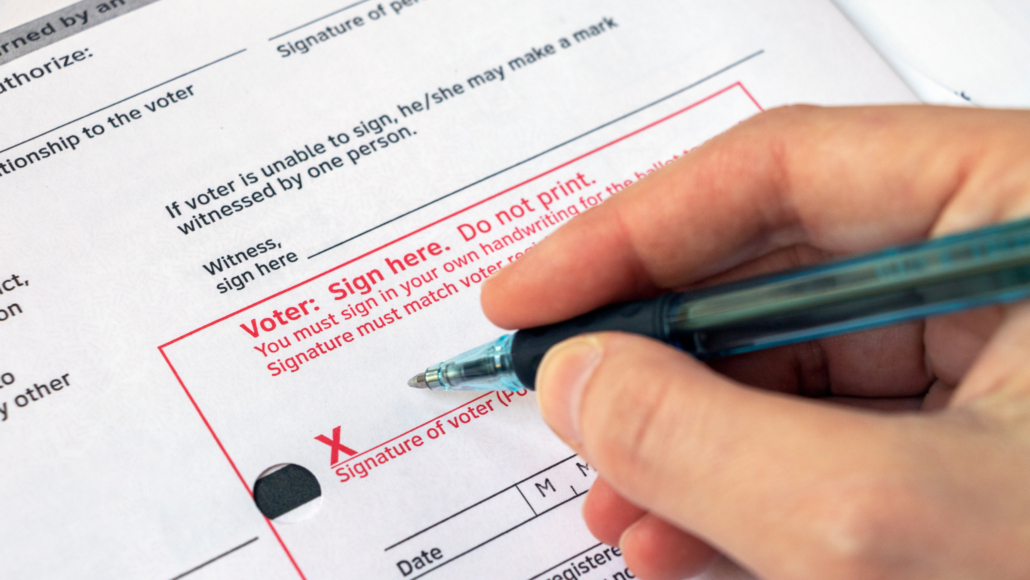
LOS ANGELES (September 14, 2026) — Young and non-White voters are substantially more likely to have their vote-by-mail ballots rejected, while experimental evidence suggests racial cues may influence the subjective decisions involved in signature verification, according to a new research brief from the UCLA Voting Rights Project (VRP).
More than 580,000 vote-by-mail ballots were rejected nationwide during the 2024 general election. Signature discrepancies were the leading reason for rejection, accounting for 59% of rejected ballots in California and 64% in Washington state.
The brief authored by Michael Herndon, a senior research fellow at the VRP, finds that the subjective process of signature verification disproportionately penalizes non-White voters and young voters in both states. In an analysis of Washington state election data, Hispanic-surnamed voters were approximately twice as likely as White voters to have their ballots rejected because of a signature mismatch. In some counties this disparity was even larger. For example, in Adams County, Hispanic voters experienced a rejection rate more than four times that of White voters between 2019 and 2024.
The research also found:
- Young voters faced substantially higher rejection rates. Across every racial group examined in California’s 2022 general election, voters younger than 25 were considerably more likely to have their signatures rejected than voters older than 65. In Riverside County, Latino voters younger than 25 were 15 times more likely to experience a signature rejection.
- Racial cues influenced signature-matching decisions in controlled experiments. In one experiment, participants accepted signatures assigned White-sounding names at a rate of 60.5%, compared with 55% for signatures assigned Hispanic-sounding names—even though the names were randomly assigned and the underlying signatures were comparable.
The experiments did not examine actual election workers, but the findings raise questions about whether personal biases can affect VBM ballot verification, especially considering that the process varies by county, is done under time constraints, and happens at a massive scale.
“A signature isn’t just a mark on a page; it also carries with it a name, which can very easily signal a person’s gender, race, religion or other personal characteristics,” said Herndon. “Decades of research tell us that people respond to these name-based cues, and they do it most when a task is ambiguous and left to their own judgment—which is exactly the case for signature verification.”
Herndon argues that the growing use of vote-by-mail makes closer examination of signature verification increasingly important. Because voters are not physically present when their ballots are reviewed, local election officials typically verify their identity by comparing the signature on the ballot envelope with signatures in the voter’s registration record. Voters whose ballots are flagged for missing or mismatched signatures must complete a curing process before their ballots can be counted, though not all states offer this remedy
The brief recommends evaluating differences in signature-review procedures and rejection rates across counties, broadening recruitment for the elections workforce, expanding automatic ballot curing and reassessing whether signature matching should remain the default method for verifying mail ballots. It also calls for further research into which technologies, training practices and administrative workflows make ballot review more accurate and less susceptible to bias.
Read the full brief here.
About the UCLA Voting Rights Project
The UCLA Voting Rights Project was established to protect equal voting rights for all Americans through strategic litigation, social science research, and policy advocacy. The VRP seeks to ensure that all individuals are afforded equal access to the electoral process and representation in governance. For more information about the UCLA Voting Rights Project, please visit vrp.ucla.edu.
 AdobeStock
 AdobeStock


 AdobeStock