Native Voters Challenge Unequal Voting Districts in Blaine County, Montana
FOR IMMEDIATE RELEASE
UCLA VRP: Alberto Lammers, alberto@uclavrp.org
Native Voters Challenge Unequal Voting Districts in Blaine County, Montana
Represented by the UCLA Voting Rights Project and Upper Seven Law, the plaintiffs seek a new county commission map, alleging diminished Native American voting strength.
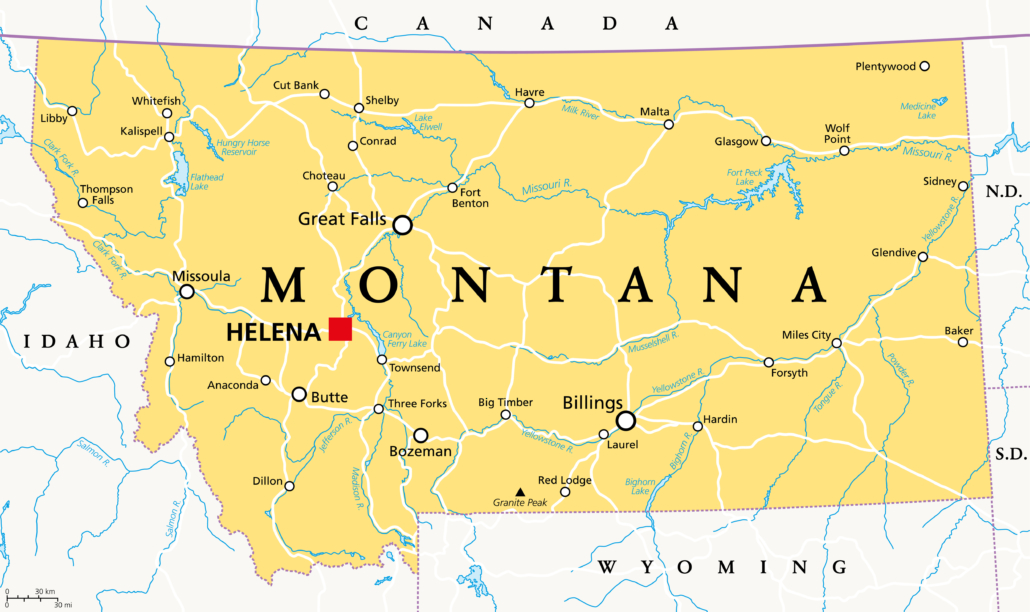
Billings, Mont. (November 5, 2026) — On Wednesday, three voters challenged the County Commissioner district map for Blaine County for violating the U.S. Constitution’s one-person, one-vote rule. The one-person, one-vote rule requires that when voters elect officials to represent them in districted bodies like county commissions, the districts must be roughly equal in population. This ensures that every person’s vote weighs the same, regardless of where they live. Blaine County’s map distributes population unequally between three districts, diluting the votes of Native American Montanans. The UCLA Voting Rights Project (VRP) and Helena-based Upper Seven Law represent plaintiffs. The suit was filed in federal district court.
In Blaine County, voters elect three commissioners from separate districts. The complaint alleges that under the existing district map, the population variation between districts exceeds constitutional limits. The County’s most populous district, District 1, is predominantly Native American and contains nearly 700 more residents than the County’s smallest district. Districts with more voters must distribute the power to elect an official across more people, which dilutes the relative power of residents in the more populous district compared to the smaller, less populous district. In Blaine County, this means that it takes approximately 1.32 people voting in District 1, the most populous district, to have the same effect as 1 person voting in District 2, the least populous district.
According to the complaint, the county’s own figures show that District 1, whose population is 94.9% American Indian, is overpopulated by 16%, while the predominantly white District 2 is underpopulated by 12%. The complaint alleges that these population disparities violate equal protection under the Fourteenth Amendment’s well-settled one person, one vote rule.
“The weight of a person’s vote should not depend on which side of a district line they live on,” said Sonni Waknin, senior voting rights counsel at the VRP. “Blaine County’s map goes against the principles of our representative government. We are asking the Court to enforce the Constitution and require districts that give voters an equal voice in their county government.”
Blaine County adopted a district-based county commissioner map in 2002, after a federal court found that the at-large system used previously diluted American Indian votes. In the years since, county officials have interpreted that earlier ruling to require them to preserve the districts’ racial composition. Plaintiffs say this interpretation is wrong and that the County’s 2024 plan retains boundaries established in 2013 despite uneven population changes, worsening existing disparities.
“The right to vote is the starting premise of our free society–it ensures that we, the people, can hold our government accountable to the rule of law,” said Molly Danahy, litigation director at Upper Seven Law. “Districts that violate the basic principle that every vote should count the same are unconstitutional. Blaine County’s Commissioner map must distribute power equally among its voters.”
Plaintiffs ask the court to declare the current map unconstitutional, prohibit its use in 2028 and any future elections, and require Blaine County to implement a plan that equalizes district populations. Defendants include Blaine County, its county commissioners, and county election officials.
About the UCLA Voting Rights Project
The UCLA Voting Rights Project was established to protect equal voting rights for all Americans through strategic litigation, social science research and policy advocacy. The VRP seeks to ensure that all individuals are afforded equal access to the electoral process and representation in governance. For more information about the UCLA Voting Rights Project, please visit vrp.ucla.edu.
About Upper Seven Law
Upper Seven Law is a Montana-based nonprofit law firm dedicated to holding the powerful accountable.
 AdobeStock
 AdobeStock