California Supreme Court Hears Challenge to Sheriff Chad Bianco’s Seizure of More Than 650,000 Riverside County Ballots
FOR IMMEDIATE RELEASE
Contact: Alberto Lammers, alammers@luskin.ucla.edu
California Supreme Court Hears Challenge to Sheriff Chad Bianco’s Seizure of More Than 650,000 Riverside County Ballots
UCLA Voting Rights Project argues that criminal investigations cannot bypass California’s established procedures for the custody and handling of voted ballots
SAN FRANCISCO (August 24, 2026) – The California Supreme Court heard oral arguments Monday in Cervantes et al. v. Bianco, a case brought by the UCLA Voting Rights Project (VRP) on behalf of four Riverside County voters challenging Sheriff Chad Bianco’s seizure and handling of more than 650,000 ballots cast in the November 2025 special election.
The petitioners are asking the Court to order all seized ballots and election materials returned to the Riverside County Registrar of Voters. They are also seeking a written accounting of how the materials were handled while outside the Registrar’s custody and disclosure of any destruction or alteration of seals, tapes, ballots or related election records.
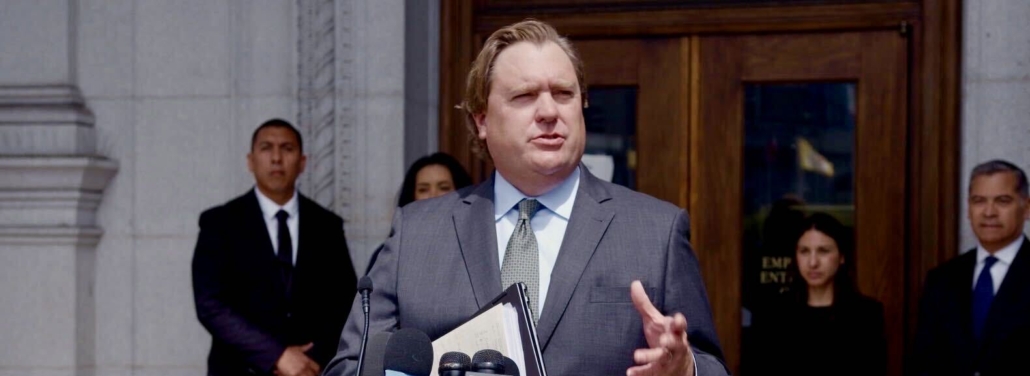
VRP Legal Director Chad Dunn argued on behalf of the voters that California law already provides specific mechanisms for challenging election results and reviewing voted ballots, and that Sheriff Bianco did not follow those procedures before seizing the ballots and beginning to count them outside the custody of Riverside County election officials.
During the 95-minute oral argument, the Court heard from counsel representing the Riverside County voters, California Attorney General Rob Bonta as amicus curiae, Secretary of State Shirley Weber, Sheriff Bianco, and Riverside County Registrar of Voters Art Tinoco. Dunn opened for the petitioners and returned for rebuttal.
Dunn, attorneys, and petitioners told reporters during a press conference following the hearing that under those procedures, ballots can be inspected or recounted when necessary, but the Riverside County Registrar of Voters remains responsible for their custody and security.
“What we’ve asked the court today to do is make sure sheriffs and everybody else in this state understand the Elections Code applies to them as well,” Dunn said.
“A criminal investigation is not a blanket license to ignore California election laws,” said Sonni Waknin, senior staff attorney at VRP and counsel for the petitioners. “Public confidence in our elections depends on voters knowing that the rules that govern their ballots will be followed.”
Xavier Becerra, senior advisor to the UCLA Voting Rights Project, former California Attorney General, and an attorney of record in the case, joined the Riverside County voters and VRP attorneys outside the Court following oral argument.
“We hope that the Supreme Court of California will issue a swift decision protecting the right to vote, protecting the ballots that are cast by our voters, so we can once again give our voters the confidence to know that when they go out and do their democratic duty and cast their vote, it not only will be counted, it will be protected,” Becerra said.
Riverside City Councilmember Clarissa Cervantes, one of the voters represented in the case, said the stakes extend beyond the immediate dispute over the seized ballots. “Protect the future of our elections, protect our ballots and our vote.”
Indio City Councilmember Oscar Ortiz, also a petitioner, called for the ballots to be returned to election officials. “Our residents deserve better from our state and county leadership, and they deserve immediate action from the California Supreme Court to return these ballots.”
Watch the August 24, 2026, press conference here.
What happens next
The California Supreme Court did not issue a decision following oral argument. The Court will now deliberate and prepare a written opinion.
Under the Court’s procedures, its opinion must be filed within 90 days of oral argument, meaning a decision is expected by late November. The ruling could provide statewide guidance on how California election laws governing voted ballots apply when those materials become relevant to a criminal investigation.
Background
The UCLA Voting Rights Project filed an original petition with the California Supreme Court on March 25 on behalf of Riverside County voters Clarissa Cervantes, Oscar Ortiz, Rebecca Robinson, and Nathan Kempe after Bianco seized voted ballots and other election materials from the Riverside County Registrar of Voters as part of an investigation into alleged discrepancies in the November 2025 election.
The petitioners argue that California election law establishes specific safeguards governing the custody, inspection, counting, and preservation of voted ballots and that a criminal search warrant does not allow law enforcement to bypass those requirements.
As the case proceeded, VRP continued to raise concerns with the Court about the seizure and handling of the election materials. The California Supreme Court ultimately ordered the parties to address whether the voters are entitled to have the cast ballots returned to the Registrar on the grounds that their seizure pursuant to search warrants violated the Elections Code.
In their June 29 filing, the petitioners asked the Court to return the ballots and election materials to the Registrar, require an accounting of their handling while outside election officials’ custody, and disclose whether any ballot seals, tapes, ballots or records had been damaged, destroyed or altered.
The Court also heard arguments Monday in the related matter Attorney General of the State of California v. Bianco, S295901. That case raises a separate question involving the Attorney General’s authority over local law enforcement. The two matters arise from the same Riverside County ballot seizure but present distinct legal issues.
###
ABOUT the UCLA Voting Rights Project
The UCLA Voting Rights Project was established to protect equal voting rights for all Americans through strategic litigation, social science research and policy advocacy. The VRP seeks to ensure that all individuals are afforded equal access to the electoral process and representation in governance. For more information about the UCLA Voting Rights Project, please visit vrp.ucla.edu.



 AdobeStock

 AdobeStock