Tag Archive for: Chad Dunn

FOR IMMEDIATE RELEASE
Contact: Alberto Lammers; alammers@luskin.ucla.edu

UCLA Voting Rights Project Asks California Supreme Court for Immediate Stay in Riverside Election Materials Case

LOS ANGELES (March 30, 2026) — The UCLA Voting Rights Project (VRP) today filed a reply with the California Supreme Court asking the Court to immediately stay any further seizure and handling of ballots and election materials while this case proceeds. In the filing, VRP argues that this matter cannot wait because Riverside voters’ rights are being harmed now, the sheriff has continued removing election materials, and no other plain, speedy, or adequate remedy exists to protect the integrity of the electoral process. 

“We are asking the Court to act immediately to stop any further seizure or handling of ballots and election materials while this case is considered,” said Sonni Waknin, Senior Voting Rights Attorney at the VPR. “Contrary to Sheriff Bianco’s statement, Riverside voters absolutely have standing to bring this challenge. The harm is ongoing, and waiting for some other process to unfold would only deepen the damage to public confidence in the system.” 

“Our election law is clear that voted ballots are to remain in the custody of election officials, and nothing the sheriff has presented changes that basic rule,” Waknin added. “The Court should issue a stay now, return lawful custody where it belongs, and prevent any further interference with the handling of election materials.”

ABOUT the UCLA Voting Rights Project

The UCLA Voting Rights Project was established to protect equal voting rights for all Americans through strategic litigation, social science research and policy advocacy. The VRP seeks to ensure that all individuals are afforded equal access to the electoral process and representation in governance. For more information about the UCLA Voting Rights Project, please visit vrp.ucla.edu.
###

FOR IMMEDIATE RELEASE
Contact: Alberto Lammers; alammers@luskin.ucla.edu

UCLA Voting Rights Project Notifies California Supreme Court of New Developments in Riverside Election Materials Seizure

Letter cites new reporting from The New York Times, indicating that no special master has been appointed and that Sheriff Chad Bianco seized 426 additional boxes of election materials from the Riverside County Registrar.

LOS ANGELES (March 27, 2026) — The UCLA Voting Rights Project (VRP) today notified the California Supreme Court of new developments in its pending petition arising from Riverside County Sheriff Chad Bianco’s seizure of election materials.

In a letter filed with the Court, petitioners pointed to new reporting by The New York Times indicating that no special master has been appointed in connection with the sheriff’s actions, despite a video recording of Bianco where he claims to the contrary. The filing also cites the Times’ reporting that Bianco seized 426 boxes of new election materials from the Riverside County Registrar on Tuesday of this week.

The letter was filed as the California Supreme Court considers next steps in the case, which has been docketed as Case No. S295866.

“These new developments make an already serious situation even more alarming,” said Sonni Waknin, Senior Voting Rights Attorney of the VRP. “California law is very clear. Election materials are to remain in the custody of election officials and be handled through established public processes. The reported seizure of additional boxes of election materials, without the appointment of a special master, only deepens the urgency of judicial intervention.”

VRP Senior Voting Rights Advisor and former California Attorney General, Xavier Becerra, stated, “Today we filed an additional briefing with the Supreme Court documenting that Sheriff Bianco continues to violate the law by removing ballots and election materials from the Registrar of Voters Office. We are calling on the California Supreme Court to order Sheriff Bianco to immediately return all ballots and election material to the custody of the Riverside County Registrar of Voters.”

In the filing, petitioners argue that these developments are causing irreparable harm to the integrity of the electoral process and undermining public confidence in elections. The letter asks the Court to exercise jurisdiction over the matter, as the scope of the seizure continues to expand.

The VPR filed its original writ petition with the California Supreme Court on March 26, 2026, seeking immediate relief in response to the sheriff’s seizure of election materials from the Riverside County Registrar of Voters.

ABOUT the UCLA Voting Rights Project

The UCLA Voting Rights Project was established to protect equal voting rights for all Americans through strategic litigation, social science research and policy advocacy. The VRP seeks to ensure that all individuals are afforded equal access to the electoral process and representation in governance. For more information about the UCLA Voting Rights Project, please visit vrp.ucla.edu.

FOR IMMEDIATE RELEASE
Contact: Alberto Lammers; alammers@luskin.ucla.edu 

UCLA Voting Rights Project Files Petition with California Supreme Court to Stop Illegal Vote Count By Riverside County Sheriff Chad Bianco

LOS ANGELES (March 26, 2026) – The UCLA Voting Rights Project (VRP), along with VRP Senior Voting Rights Advisor and former California Attorney General, Xavier Becerra, filed a petition with the California Supreme Court today asking them to direct Riverside County Sheriff Chad Bianco to return all seized ballots to their rightful place at the Riverside County Registrar of Voters Office.

The VRP lawsuit contends that under multiple provisions of California law, all voted ballots have to remain in the custody of the County Registrar of Voters, and ballots are not permitted to be handled, canvassed, or counted by anyone outside the official elections staff.  The lawsuit further contends that Sheriff Bianco’s attempt to use criminal investigation authority does not override the Legislature’s clear commandments on the handling of election materials.

During his press conference on March 20, 2026, Mr. Bianco admitted that his office had seized and begun counting cast ballots from the 2025 Special Election. While Mr. Bianco does have the power of investigation, he does not have any legal authority to remove ballots from the Registrar of Voters’ office, and he does not have any legal authority to preside over a recount. Importantly, none of these things can occur outside of public view, as has been the case.  

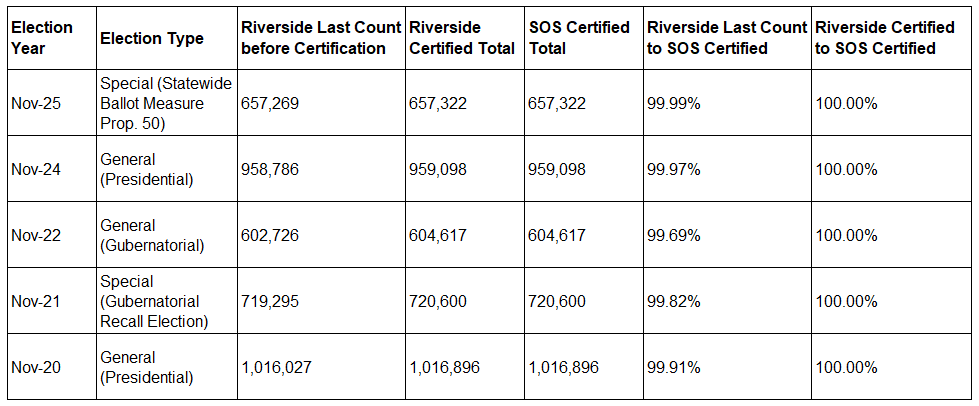
Further, as the Attorney General has noted, the suspicions Sheriff Bianco asserts are insufficient to support tarnishing the vote totals as announced by Riverside County after the election. Riverside County has a proven track record of accurately tabulating ballots.  According to data from the Riverside County elections website, and crosschecked against the California Secretary of State website, in every election from November 2020 to November 2025, the final vote tally before certification has matched the final certified vote tally by 99.7% or higher. In all five elections, the Riverside certified vote tally matches to 100% the California Secretary of State certified vote tally to the exact same number.  (See Table 1 on the following page).

Becerra, VRP Senior Voting Rights Advisor, stated, “Our election laws are clear: voter ballots are sacred and must be protected from tampering. Riverside County Sheriff Chad Bianco is supposed to enforce the law, not break it. His reckless seizure of more than 650,000 ballots from the 2025 special election and his attempt to oversee a recount not only violate California election law but are based on no credible evidence whatsoever. Law enforcement officials are legally prohibited from interfering in counting ballots, in California and nationwide.”

Chad Dunn, Director of Litigation of the VRP and adjunct professor in the UCLA School of Law and Luskin School of Public Affairs, stated, “The UCLA Voting Rights Project was established to train new voting rights practitioners in the constant struggle to protect our democracy by ensuring the rule of law governs elections. It is fitting that the VRP, with its election law expertise, steps in on behalf of Riverside County citizens to protect their right to vote. This Petition asserts that the California Legislature has adopted careful and meticulous protections and procedures, common across the states, to ensure accurate election outcomes that the public can and should trust. What is going on in Riverside County is in violation of these laws, and the Petition asks that the California Supreme Court regain control of these election materials.” 

Read the petition here.

Table 1: Comparison of Vote Tally for Riverside County to Secretary of State Certified Results

ABOUT the UCLA Voting Rights Project

The UCLA Voting Rights Project was established to protect equal voting rights for all Americans through strategic litigation, social science research and policy advocacy. The VRP seeks to ensure that all individuals are afforded equal access to the electoral process and representation in governance. For more information about the UCLA Voting Rights Project, please visit vrp.ucla.edu.

###

Data Source for Riverside County:

https://voteinfo.net/november-4-2025-statewide-special-election

https://voteinfo.net/november-5-2024-election

https://voteinfo.net/november-8-2022-consolidated-general-election-0

https://voteinfo.net/september-14-2021-california-gubernatorial-recall-election-0

https://voteinfo.net/november-3-2020-consolidated-general-election-0

Data Source for Secretary of State:

https://elections.cdn.sos.ca.gov/sov/2025-special/sov/03-voter-participation-stats-by-county.pdf

https://elections.cdn.sos.ca.gov/sov/2024-general/sov/03-voter-participation-stats-by-county.pdf

https://elections.cdn.sos.ca.gov/sov/2022-general/sov/03-voter-participation-stats-by-county.pdf

https://elections.cdn.sos.ca.gov/sov/2021-recall/sov/03-voter-participation-stats-by-county.pdf

https://elections.cdn.sos.ca.gov/sov/2020-general/sov/03-voter-participation-stats-by-county.pdf

LOS ANGELES (March 5, 2026) — Earlier today, Governor Gavin Newsom, Senate President pro Tempore Monique Limón, and Assembly Speaker Robert Rivas announced a joint commitment to protecting California’s elections from potential federal interference. The announcement comes as states across the country face increasing pressure on election administration and new efforts that could undermine voter access. 

Statement from Matt Barreto, faculty director of the UCLA Voting Rights Project, released the following statement:

“The UCLA Voting Rights Project (UCLA VRP) is proud to be an anchor member of the California Democracy Partnership, a group of voting rights legal experts, policy advocates, and community organizers committed to preserving democracy in California. Today, UCLA VRP applauds the commitment made by Governor Gavin Newsom, Senate President pro Tempore Monique Limón, and Assembly Speaker Robert Rivas to protect and defend our democracy.

“Just this week, we saw vote suppression on display in Dallas and Williamson County, Texas, where state leaders, employing an obscure state law, forced local election officials to make voting harder for everyone. Chad Dunn, legal director of the UCLA VRP, was part of the team on the ground in Texas working to allow all voters to cast their ballots on Election Day.

“In particular, one of these forced changes by the state of Texas was to assign a specific polling location to each voter and insist that the voter use that location and no other in the county. This represented a last-minute change from the way previous elections had been run for years. What is worse, the voter registration system that the state insisted these counties use was in such disarray that a voter who was trying to find their assigned location was told one location by state officials and a different location by county officials. Predictably, up to half of voters were turned away from the polls on Election Day, some given wrong information about where they should go next. Some voters stood in lines, sometimes twice, for hours.

When Dallas County reasonably sought to extend the voting period by two hours, a local judge agreed. However, within an hour, the Texas attorney general went to the Texas Supreme Court and secured a stay to block the polls from staying open. The Texas Supreme Court left the impression that any votes cast during the extended time would not be counted.

The lessons from Texas in March 2026 should reverberate nationally. Rather than confusing and frustrating voters or erecting new obstacles, there is an opportunity for California to become a national leader in protecting the right to vote for all citizens of all racial groups and all political affiliations.

California has already championed the Voter’s Choice Act and universal vote-by-mail, but the ongoing threat to our democracy continues to loom. California and its leadership are positioned to fight back and fulfill the promise of the fundamental right to vote.

ABOUT the UCLA Voting Rights Project

The UCLA Voting Rights Project was established to protect equal voting rights for all Americans through strategic litigation, social science research and policy advocacy. The VRP seeks to ensure that all individuals are afforded equal access to the electoral process and representation in governance. For more information about the UCLA Voting Rights Project, please visit vrp.ucla.edu.

###

El Paso, Texas (November 19, 2025) — Tuesday, a three-judge federal panel ruled in favor of Hispanic and Black voters in League of United Latin American Citizens (LULAC) et al. v. Abbott, finding that Texas’s 2025 congressional map racially gerrymandered Black and Hispanic voters in multiple congressional districts. Leading the legal team and political science expert witnesses for the plaintiffs was the UCLA Voting Rights Project (VRP), directed by Dr. Matt A. Barreto and Chad W. Dunn, JD, in the Luskin School of Public Affairs.

The comprehensive 160-page opinion marks a major victory for voting rights advocates who argued the map was drawn “focusing on race,” fragmenting and concentrating underrepresented communities to weaken their political influence. The opinion, authored by Judge Jeffrey Brown, previously appointed by Donald Trump in 2019, references the work led by Dunn on behalf of the Brooks plaintiffs 129 times in the decision to strike down the Texas map.

In doing so, the Court determined that there was direct evidence that race predominated in the drawing and adoption of the 2025 Texas Congressional map.  The 2025 map attempted to dismantle four racial-majority coalition districts that elect Hispanic and Black members of Congress. In finding that there was direct evidence of the use of race in the redistricting process, the Court highlighted the United States Department of Justice’s demand to dismantle four congressional districts on the basis of their racial composition, Governor Greg Abbott’s statements that redistricting was undertaken to respond to the Department of Justice, and statements by the legislative sponsor of the 2025 redistricting plan that stated they were “compelled” to act to dismantle majority racial coalition districts. 

“The court’s decision affirms what the data made crystal clear — that Texas’s mapmakers engineered districts based on race that stripped Latino voters of fair representation and overly-packed Black voters into districts diluting their voice,” said Dr. Barreto. “While gerrymandering may be the new wave of 2025, it remains illegal to dilute and diminish representation on the basis of race.  Giving all voters an equal voice strengthens the foundation of our democracy; UCLA social science, public policy and law students who chose to work on this case gained tremendous experience.”

“A three-judge federal court is one of the toughest venues for trial lawyers. The state of Texas has nearly unlimited resources at their disposal to defend its racially discriminatory map.  Many members of the UCLA VRP team committed their talents to this effort and, as a result, students gained valuable clinical education.   We knew that the facts and the law were on the side of the voters,” said Dunn.

Background:

As a result of VRP attorneys participation, UCLA students and fellows enjoyed a rare chance to engage in a highest of stakes voting rights educational opportunity. VRP’s Legal Director and Lecturer of Law, Chad Dunn, joined by Senior Voting Rights attorney, Sonni Waknin, in their private capacities, represented Hispanic and Black voters across Texas, specifically alleging that the congressional map was intentionally discriminatory and drawn to dismantle existing Hispanic opportunity districts in Dallas-Fort Worth, Houston, Central Texas, and the Gulf Coast area, and pack Black voters in the Dallas-Fort Worth and Houston areas. 

Dunn served as the lead counsel for the Brooks plaintiffs and led the direct examinations of witnesses, including Black and Hispanic Texas legislators opposed to mid-decade redistricting who had argued forcefully during the legislative debates that the new plan was discriminatory.  UCLA students helped prepare these examinations and performed critical work presenting fact and expert evidence.  Dunn was also the lead cross-examiner of key legislators in the redistricting process. Waknin, with the assistance of Luskin and Law students, was the lead author of a 100-plus post-trial briefing on behalf of the individual voters, LULAC, and the Mexican American Legislative Caucus (MALC).  

During the proceeding, VRP’s faculty director, Dr. Barreto, testified as an expert witness on behalf of the Brooks and MALC plaintiffs and individual voters. He teamed up with VRP senior data scientist Michael Rios to author two expert reports and a rebuttal report submitted as evidence to the Court. The Barreto and Rios reports provided critical statistical evidence that the 2025 Texas congressional map used racial targets when drawing district boundaries and provided data analysis that showed the effect of the map on Latino/a and African-American communities. 

Barreto and Rios were assisted by data science fellow Emma Kim, who ran hundreds of models of voter behavior over the course of multiple expert reports and found that majority-White voters are bloc-voting against Hispanic and Black candidates of choice. Their findings showed the map’s disproportionate impact on Latino and Black voters.. VRP’s program manager, Madeline Martinez, volunteered her efforts to coordinate the clinical opportunity for students and fellows while also ensuring a careful attention to all the details that allowed a smooth presentation of evidence in the trial.

Law, graduate, and undergraduate fellows with VRP who desired to work on the case also gained valuable real-world experience and provided critical assistance throughout the trial. Ph.D. student Ananya Hariharan created dispersion plot maps highlighting racial gerrymandering. Law students Vivian Alejandre, Matthew Cooke, Grayson Rost, and undergraduate researcher Carl Maier assisted in pre-trial preparation, evidence review, exhibit preparation, and post-trial briefing. 2L and 3L law students, currently enrolled in the VRP Fall course, provided critical assistance, including helping review thousands of hours of legislative videos for excerpts to use at trial. 

The Texas case will likely be heard by the U.S. Supreme Court giving UCLA students an exceptional clinical opportunity to help prepare the appeal to support why the 3-judge federal court in El Paso used the correct legal reasoning in declaring the new Texas map unconstitutional.

ABOUT THE UCLA VOTING RIGHTS PROJECT

The UCLA Voting Rights Project was established to protect equal voting rights for all Americans through strategic litigation, social science research and policy advocacy. The VRP seeks to ensure that all individuals are afforded equal access to the electoral process and representation in governance. For more information about the UCLA Voting Rights Project, please visit vrp.ucla.edu.

Memo Accompanied by Theoretical Data Map Demonstrating Potential for Implications for Democrats and Republicans

LOS ANGELES (July 31, 2025) — As Texas advances a mid-decade congressional redistricting plan and California Governor Gavin Newsom signals openness to similar action, the UCLA Voting Rights Project (VRP) has released a legal and mapping analysis as leaders give thought to any policy action/  The legal memo argues that the text of the California Constitution continues to recognize the power of the Legislature to redistrict at least in some circumstances. 

The VPR analysis provides a textual analysis of the California Constitution and concludes that neither Proposition 11 nor Proposition 20 stripped the Legislature of its power to establish or change congressional districts. While the Citizens Redistricting Commission remains responsible for drawing maps following the decennial census, the constitution text still recognizes that the Legislature can act independently at other times.

On the mapping side, to illustrate what is practically possible based on the state’s geography, population, and voting patterns, VRP mapping experts have released metrics on a theoretical congressional data map showing how new lines could result in additional Democratic-leaning districts across California. The map is not a policy recommendation or endorsement, but rather a data-informed contribution to the public discourse on redistricting.

Matt Barreto, faculty director of the VRP, said, “As an independent and theoretical exercise, we wanted to see if Governor Newsom’s objective was legally and practically possible. This map demonstrates it is possible to legally draw up to 50 congressional districts in California that are Democratic opportunity seats. If the state legislature and Governor decide to move in that direction, there are easily enough Democratic communities in California to achieve his goal.”

“The UCLA VRP is committed to the equal right to vote for all citizens regardless of their race, ethnicity, or preferences for policies or political parties. Our lawyers and experts have advocated to courts (including the U.S Supreme Court) and Congress for measures that would protect voters from state and local governments that dilute their votes based on their race, ethnicity, and/or viewpoints. States are right to enact laws that ensure their legislatures fairly represent the public. The Supreme Court and Congress should police partisan gerrymanders as violative of the First and Fourteenth Amendments.  When it comes to fair representation in Congress, we need a national policy. Without a national policy, it is a worthwhile exercise for state leaders to consider what steps they can take to ensure Congress is at least representative of the Nation as a whole,” said Chad Dunn, legal director of the VPR. 

Read the legal memo and review the map here.

ABOUT THE UCLA VOTING RIGHTS PROJECT

The UCLA Voting Rights Project is the marquee advocacy project of the UCLA Latino Policy and Politics Institute at the University of California, Los Angeles and is focused on voting rights litigation, research, policy, and training. The UCLA Voting Rights Project addresses monumental and overlooked gaps in the field of voting rights: how to train young lawyers and researchers, support the development of new legal and methodological theories for voting rights cases, and how to advance policy work to ensure that there is a new generation of leaders who are pursuing efforts to guarantee all citizens have equal and fair access to our democracy. The project was founded by Chad W. Dunn, J.D., and Matt Barreto, Ph.D. The UCLA Voting Rights Project is located within the Luskin School of Public Affairs.
To learn more about the UCLA Voting Rights Project, please visit: vrp.ucla.edu